


 Cart
Cart
 sales@molnova.com



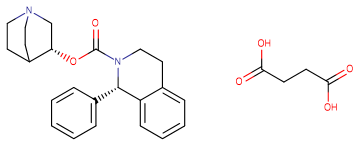
Solifenacin succinate
CAS No. 242478-38-2
Solifenacin succinate( Isoprenalinoe sulfate | YM-67905 )
Catalog No. M13700 CAS No. 242478-38-2
Solifenacin Succinate(YM905; Vesicare) is a muscarinic receptor antagonist.
Purity : >98% (HPLC)
 COA
Datasheet
HNMR
HPLC
MSDS
Handing Instructions
COA
Datasheet
HNMR
HPLC
MSDS
Handing Instructions
| Size | Price / USD | Stock | Quantity |
| 10MG | 38 | In Stock |


|
| 50MG | 42 | In Stock |
|
| 100MG | 80 | In Stock |
|
| 200MG | 109 | In Stock |
|
| 500MG | Get Quote | In Stock |
|
| 1G | Get Quote | In Stock |
|
Biological Information
-
Product NameSolifenacin succinate
-
NoteResearch use only, not for human use.
-
Brief DescriptionSolifenacin Succinate(YM905; Vesicare) is a muscarinic receptor antagonist.
-
DescriptionSolifenacin Succinate(YM905; Vesicare) is a muscarinic receptor antagonist.(In Vitro):Solifenacin Succinate (YM905) is a novel muscarinic receptor antagonist with pKis of 7.6±0.056, 6.9±0.034 and 8.0±0.021 for M1, M2 and M3 receptors, respectively. In murine submandibular gland cells, the antagonistic effects of 100 nM Solifenacin Succinate and oxybutynin on Ca2+ mobilization evoked by varying doses of carbachol (CCh) are examined. Solifenacin Succinate does not shift the CCh dose-activation curve in a parallel manner whereas oxybutynin shows insurmountable antagonism. The pKb values are obtained as 7.4±0.17 for Solifenacin Succinate and 8.8±0.21 for oxybutynin. (In Vivo):Solifenacin Succinate (YM905) reduces bladder responses by 40% at a dose of 210 nmol/kg (0.1 mg/kg) and abolishes them at 2100 nmol/kg (1 mg/kg). In contrast, its inhibitory effects on salivary and cardiac responses are only slight at 630 nmol/kg (0.3 mg/kg), and reach 66% and 49%, respectively, at 2100 nmol/kg (1 mg/kg). At doses of 63 and 210 nmol/kg (0.03 and 0.1 mg/kg), Solifenacin Succinate slightly increases saliva secretion. Solifenacin Succinate (0.01 to 0.3 mg/kg i.v.) dose-dependently increases bladder capacity and voided volume at doses of 0.03 mg/kg i.v. or more, but does not affect residual volume or micturition pressure at any dose tested.
-
In VitroSolifenacin Succinate (YM905) is a novel muscarinic receptor antagonist with pKis of 7.6±0.056, 6.9±0.034 and 8.0±0.021 for M1, M2 and M3 receptors, respectively. In murine submandibular gland cells, the antagonistic effects of 100 nM Solifenacin Succinate and oxybutynin on Ca2+ mobilization evoked by varying doses of carbachol (CCh) are examined. Solifenacin Succinate does not shift the CCh dose-activation curve in a parallel manner whereas oxybutynin shows insurmountable antagonism. The pKb values are obtained as 7.4±0.17 for Solifenacin Succinate and 8.8±0.21 for oxybutynin.
-
In VivoSolifenacin Succinate (YM905) reduces bladder responses by 40% at a dose of 210 nmol/kg (0.1 mg/kg) and abolishes them at 2100 nmol/kg (1 mg/kg). In contrast, its inhibitory effects on salivary and cardiac responses are only slight at 630 nmol/kg (0.3 mg/kg), and reach 66% and 49%, respectively, at 2100 nmol/kg (1 mg/kg).At doses of 63 and 210 nmol/kg (0.03 and 0.1 mg/kg), Solifenacin Succinate slightly increases saliva secretion. Solifenacin Succinate (0.01 to 0.3 mg/kg i.v.) dose-dependently increases bladder capacity and voided volume at doses of 0.03 mg/kg i.v. or more, but does not affect residual volume or micturition pressure at any dose tested.
-
SynonymsIsoprenalinoe sulfate | YM-67905
-
PathwayEndocrinology/Hormones
-
TargetAChR
-
RecptormAChR
-
Research AreaNeurological Disease
-
Indication——
Chemical Information
-
CAS Number242478-38-2
-
Formula Weight480.56
-
Molecular FormulaC23H26N2O2·C4H6O4
-
Purity>98% (HPLC)
-
SolubilityEthanol: 5 mg/mL (10.4 mM); Water: 96 mg/mL (199.77 mM); DMSO: 3 mg/mL (6.24 mM)
-
SMILESC1CN2CCC1[C@H](C2)OC(=O)N3CCC4=CC=CC=C4[C@@H]3C5=CC=CC=C5.C(CC(=O)O)C(=O)O
-
Chemical Name——
Shipping & Storage Information
-
Storage(-20℃)
-
ShippingWith Ice Pack
-
Stability≥ 2 years
Reference
1.Sinha S, et al. Br J Pharmacol. 2010 Jul;160(5):1119-27.
molnova catalog



related products
-
Dextromethorphan HBr...
Methyl analog of dextrorphan that shows high affinity binding to several regions of the brain, including the medullary cough center.
-
Choline chloride
Choline chloride is an organic compound and a quaternary ammonium salt, an acyl group acceptor and choline acetyltransferase substrate.
-
PSEM 89S TFA
PSEM 89S TFA is a brain-penetrant and selective ion channels agonist, and is orthogonally selective for Q79G and L141F, respectively.
